Debonair is a comprehensive Mars rover system developed as the culminating project for the second-year Engineering Design Project at Imperial College London. This ambitious undertaking brought together multiple engineering disciplines to create a sophisticated autonomous vehicle capable of operating in three distinct modes.
The rover features autonomous exploration capabilities where it independently navigates target environments while identifying and reporting obstacle positions. In coordinate mode, the system accepts destination coordinates and autonomously plots optimal paths while avoiding detected obstacles. For manual control scenarios, users can directly pilot the rover through a responsive web interface.
At the heart of the system lies a carefully architected communication infrastructure. An ESP32 microcontroller manages all communications between the rover and a cloud-based server, utilizing MQTT protocol for reliable message delivery. The backend REST API, hosted on AWS, handles pathfinding algorithms and coordinates data flow between subsystems. A React-based web application provides an intuitive control hub where operators can seamlessly switch between operational modes and monitor real-time telemetry.
The drive subsystem implements precise motor control using Arduino Nano Every microcontrollers, enabling smooth navigation across varied terrain. Computer vision capabilities allow the rover to detect and map obstacles in real-time, feeding this critical data into the pathfinding algorithms. The energy management system ensures reliable power distribution across all components, essential for extended autonomous operations.
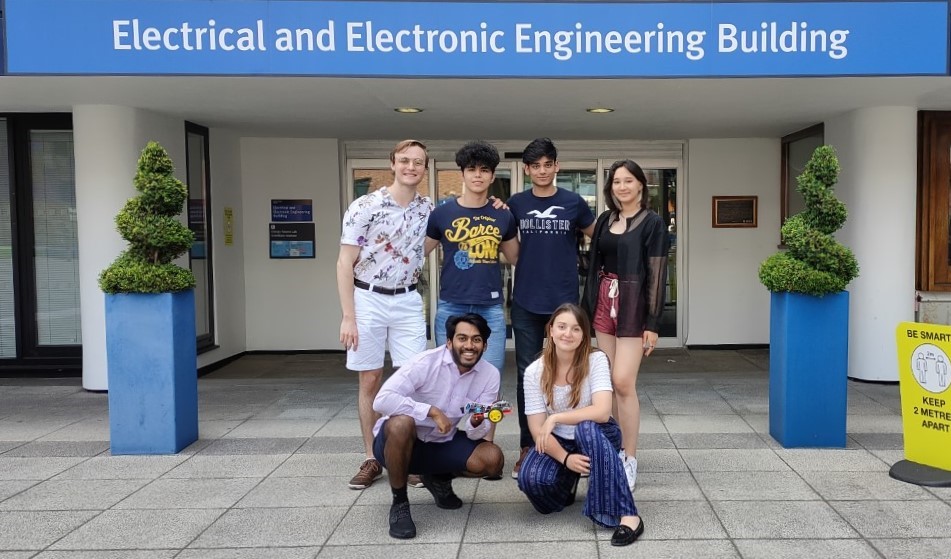
Development involved close collaboration across six team members, each specializing in different subsystems while maintaining tight integration through standardized interfaces and comprehensive testing protocols. The project successfully demonstrated full system integration through live demonstrations, showcasing capabilities in both controlled environments and challenging obstacle courses.
The complete system architecture, including detailed technical documentation and source code, represents a production-quality implementation suitable for educational and research applications. A demonstration video showcasing the rover’s capabilities in action can be viewed at the project repository, highlighting the seamless integration of hardware, software, and cloud infrastructure components.